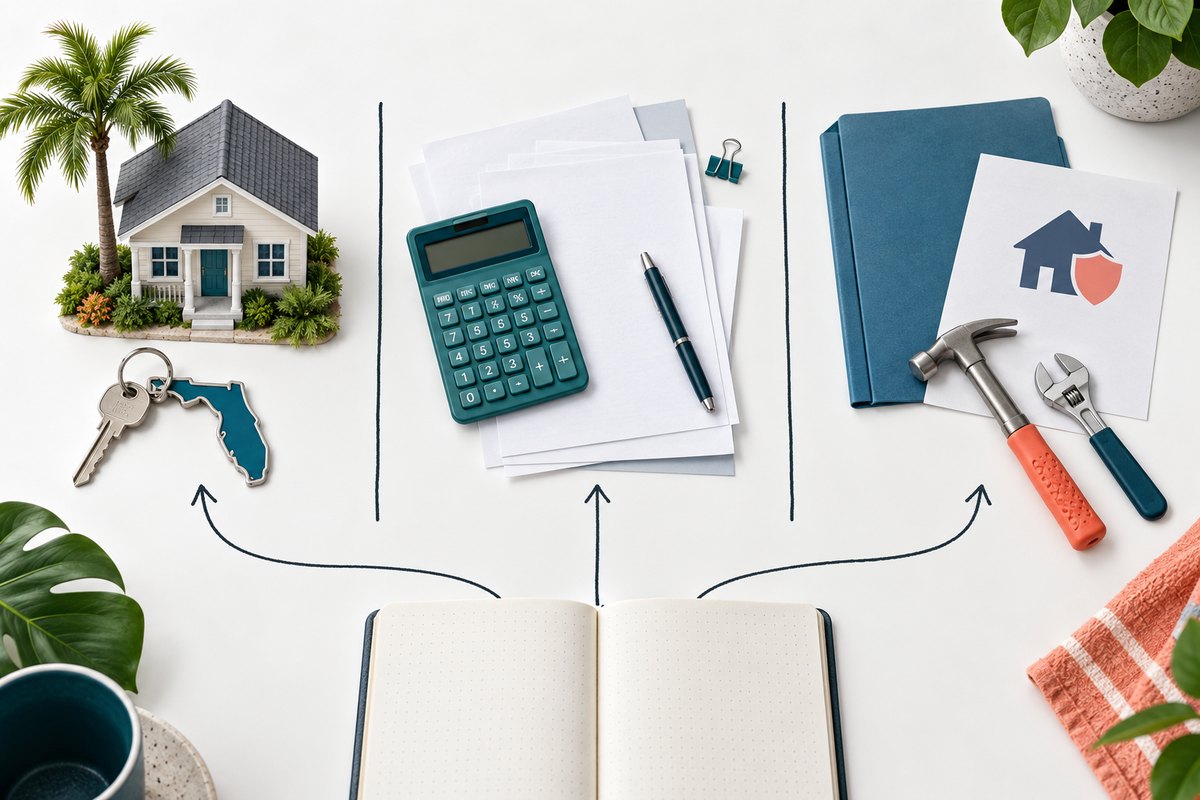
A report about a house can look reassuring without answering the question you actually have. 'What is it worth?' differs from 'What needs attention?' and from 'What information does the insurer need?' Florida buyers and aspiring real estate agents benefit from keeping those questions separate.
Start by identifying who requested each report, its purpose and its scope. Similar photographs or repeated descriptions of the roof do not make two reports interchangeable.
One property, four different questions
Home inspection
What does the accessible condition of the home reveal?
Appraisal
What is the professional opinion of value?
Four-point report
What condition information does the insurer need?
Wind mitigation
Which protective features can be documented?
A home inspection focuses on condition
Florida's Department of Business and Professional Regulation describes home inspection services as a limited visual examination of accessible installed systems and components, resulting in a written opinion about condition. Its description includes the structure, roof, electrical, plumbing and heating/cooling systems, among other areas. Source: DBPR home-inspector guidance.
The words 'limited' and 'accessible' matter. Do not read the report as a promise that nothing hidden can be wrong. Before booking, ask what the inspection includes, what it excludes and how inaccessible areas will be recorded.
Useful questions include:
- Can I see a sample report before choosing the service?
- Which findings would call for a separate specialist?
- Will the report distinguish an observed problem from something that could not be evaluated?
- How can I ask follow-up questions after reading it?
These questions turn a report into something you can use. A phrase such as 'further evaluation recommended' should lead to clarification, not disappear into a folder marked complete.
An appraisal addresses value
An appraisal provides an independent opinion of a property's value. A mortgage lender may obtain one or use another valuation method. The CFPB explains the distinction in its appraisal guide.
An opinion of value does not replace a condition inspection. An appraisal may also identify repairs relevant to the loan program, so value and condition are not completely isolated subjects. The CFPB's home-inspection guidance discusses that overlap.
Ask your lender what valuation process applies and how to raise a factual concern about the report. Keep the question specific: an incorrect room count or property description is different from simply wishing the value were higher.
A four-point inspection serves an insurance purpose
Citizens Property Insurance describes a four-point inspection covering the roof, electrical system, plumbing and heating/cooling system. The report records their age, type and condition for insurance eligibility review. Source: Citizens inspections guidance.
That focused scope is why a four-point report should not be treated as a substitute for a broader buyer's inspection. Nor should one insurer's requirements be presented as a rule for every Florida home or every insurance company.
Before ordering, ask your insurance professional which reports this property and application need, who may complete them and which form the insurer accepts. Also ask whether the quoted coverage remains subject to reviewing the inspection. Receiving a report and receiving confirmed coverage are different milestones.
Wind mitigation looks at protective features
A wind mitigation inspection documents features relevant to reducing wind damage and potential insurance discounts. Florida's Department of Financial Services publishes guidance on the qualified professionals and the current verification form. Source: Florida wind mitigation guidance.
Think of its purpose as documenting protection, not establishing a sale price or certifying that a home cannot suffer storm damage. Ask the inspector which documents or access they need, and ask the insurance professional how verified features affect the particular quote. Do not build a budget around an assumed discount before that review.
Use one hypothetical house to test the difference
Imagine a buyer receives an appraisal supporting the agreed purchase price, while a home inspection recommends further evaluation of a roof issue. Neither report cancels the other out. One answers a valuation question; the other identifies a condition question that remains open.
Now suppose the insurer requests a four-point report. Sending the appraisal does not automatically satisfy that request. The practical next step is to confirm the required report and reviewer, not to argue that the house has already been 'checked.'
This example is fictional. Actual contract options, loan conditions and insurance decisions depend on the transaction. Ask the responsible professionals about next steps instead of assuming a report creates an automatic right to cancel or guarantees approval.
Keep a clear report checklist
For each document, note the purpose, provider, scope, unanswered questions and person responsible for follow-up. That simple habit is useful whether you are buying a home or preparing to explain the process professionally.
Continue building your real estate vocabulary through the 63Hours course introduction and the Florida real estate practice questions. Understanding professional roles includes knowing when a question belongs with an inspector, appraiser, lender or insurance professional.